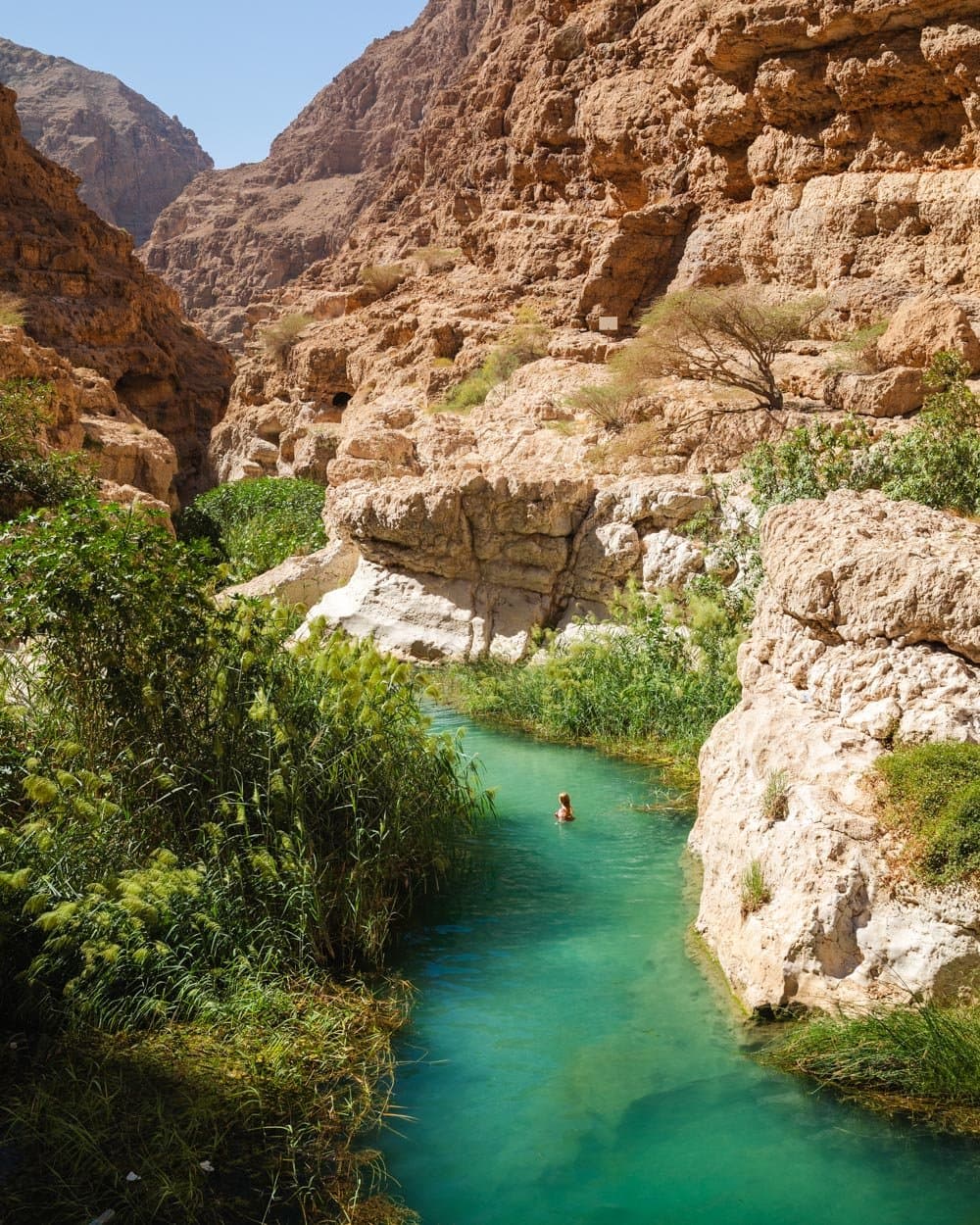
Wadi Ghul
F
ByFarees
3 min read·Published on
Wadi Ghul isn't just a valley; it’s a geological scar that plunges nearly 1,000 meters deep. As you drive toward the entrance, the massive limestone walls tower over you, displaying millions of years of rock layers. This area serves as the gateway to the highest point in Oman, where the air is thin, crisp, and significantly cooler than the plains below.
The Balcony Walk (W6 Trail): This is the "must-do" experience. It’s a narrow (but safe) ledge hike that skirts the rim of the canyon. It’s relatively flat and takes about 3–4 hours round-trip, leading you to the abandoned village of Sap Bani Khamis.
Off-Roading in the Basin: For those with a capable 4WD and experience, you can drive into the floor of the wadi (Wadi Nakhr). Looking up at the 1km-high walls from the bottom is a humbling perspective.
Stargazing: Because of the high altitude and lack of light pollution, Wadi Ghul and the Jebel Shams plateau are world-class spots for astrophotography. On a clear night, the Milky Way is visible to the naked eye.
Mountain Biking: The plateau offers rugged tracks for experienced mountain bikers looking for high-altitude training with a view.
Ghul Abandoned Village: Located right at the start of the climb, this ancient Persian-style village is built out of mud and stone, blending perfectly into the mountainside. It’s a hauntingly beautiful spot for photos.
The "Grand Canyon" Viewpoints: There are several unmarked pull-offs on the way up to the Jebel Shams resorts. Each offers a different, vertiginous angle of the 1,000m drop.
Sap Bani Khamis: An abandoned "hanging" village at the end of the Balcony Walk. You can see how people lived in caves and stone houses on the cliff edge, accessible only by a narrow mountain path.
The Hidden Lake: After heavy rains, a small, emerald-green pool often forms at the end of the Balcony Walk trail, tucked under the overhanging cliffs.
Vehicle: A 4WD is mandatory for the final 15–20km of the climb. While the road is mostly paved, there is a steep, unpaved graded section that standard cars will struggle with.
Supplies: Once you start the climb, there are no petrol stations and only a few basic shops near the resorts. Fill your tank in Al Hamra.
Safety: There are no railings at the viewpoints. Keep children close and be extremely careful when taking photos near the edge.
7:00 AM: Depart Muscat for the 2.5-hour drive to Al Hamra.
9:30 AM: Stop at the Ghul Abandoned Village for photos and to explore the lower wadi entrance.
10:30 AM: Begin the 4WD ascent to the Jebel Shams Plateau.
11:30 AM: Reach the village of Al Khitaym and start the Balcony Walk (W6).
2:30 PM: Finish the hike and head to one of the canyon-edge viewpoints for a picnic lunch (with a view into the abyss).
4:00 PM: Explore the nearby Misfat Al Abriyeen (mountain village) on your way back down.
6:00 PM: Start the drive back to Muscat as the sunset turns the limestone cliffs deep orange.
Things to Do
Places to See
Trip & Itinerary Advice
Best Time to Visit
Season: All year round, but winter (November to March) is best for hiking. In the summer, while the rest of Oman is 45°C, Wadi Ghul stays a pleasant 25°C. Note: In winter, temperatures at the top can drop to 0°C or below at night—bring heavy layers!Pro Tips
Suggested Full-Day Itinerary
F
Written by Farees
Travel writer and founder of Oman Explorer. Based in Muscat, Oman, with years of experience exploring the Sultanate's hidden gems, ancient forts, stunning wadis, and desert landscapes. Passionate about sharing authentic travel experiences and helping visitors discover the beauty of Oman.
Learn more about the authorMore Articles to Explore



Comments (0)
Sign in to comment
Create a free account or sign in to join the conversation.
No comments yet. Be the first to comment!